
Last updated: September 2026
Read this first: This article is an evaluation guide. It is not a certification claim, a legal opinion, or a substitute for the ISO/IEC 42001 standard, an accredited auditor, or professional advice.
Regulated organizations adopting agentic AI have to answer two different questions:
- What policies and controls govern the system?
- Can we demonstrate that those controls actually operated?
ISO/IEC 42001 addresses the first question. It defines the requirements for an artificial intelligence management system, or AIMS: the organizational machinery of governance, risk management, accountability, monitoring, and continual improvement.
Certification applies to that management system, never to a software product.
Installing SAFi does not make an organization certified or compliant with anything, and nothing in this article says otherwise.
SAFi contributes to the second question. SAFi is an open source governance engine for AI agents. It enforces policies in real time, governs tool calls, and records decisions for audit and review.
The gap between having a policy and proving it ran
An AI policy can say that an agent must protect confidential information or obtain authorization before acting.
The policy is necessary, but nothing else proves that the policy is being enforced.
An organization operating an AIMS may also need to demonstrate which policy version governed a specific interaction, what was evaluated, what decision was reached, whether an action was authorized before it executed, and whether human review occurred.
That's the difference between documentary evidence and operational evidence.
Documentary evidence includes policies, procedures, training records, and meeting minutes.
Operational evidence shows the controls working on actual interactions and tool calls.
SAFi is designed to provide that second layer.
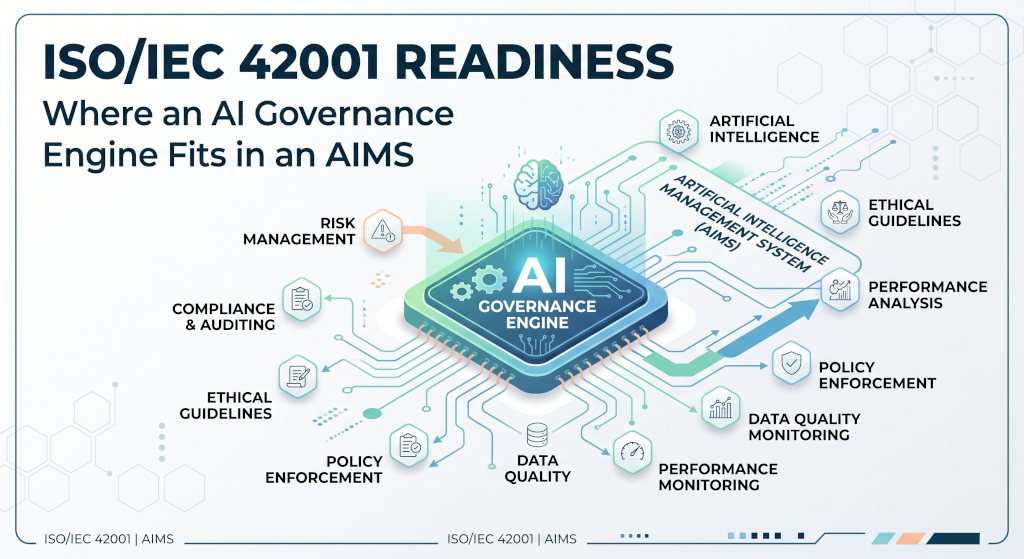
Where SAFi sits
SAFi runs at the point where an agent produces an answer or prepares to take an action.
The governing process separates five faculties:
This separation keeps generation apart from authorization, authorization apart from evaluation, and runtime decisions apart from later review.
The underlying model that fills the Intellect is changeable. The charter, policies, and audit trail remain independent of that model provider.
Every governed turn can produce an evidence record containing:
- The generated draft
- The policy version in force
- The value-by-value evaluation ledger
- The enforcement decision
- The authorization record for any tool call
- The alignment measurements used for monitoring
The runtime governance evaluation occurs before the answer is delivered, and a tool call is checked against the configured allow list before it executes.
An after-the-fact log can show what happened. A runtime governance record can also show what was evaluated and authorized before it happened.
SAFi does not make an agent correct, unbiased, or free of hallucinations.
It governs and records the decision process. Grounding quality, model behavior, and human review remain separate controls.
A practical mapping
This table is a starting point for evaluation, not a conformity assessment.
| AIMS need | Potential SAFi contribution | Organization responsibility |
|---|---|---|
| AI policies that operate in practice | Versioned charters, policies, and value rubrics evaluated during governed turns | Authoring, approving, and reviewing policies |
| Accountability and role separation | Role-based permissions and recorded supervisory dispositions | Assigning roles and maintaining accountability |
| Runtime operation records | Audit records with the draft, evaluation, decision, and policy version | Retention, review, and evidence management procedures |
| Human oversight | Supervisory review routing based on configured conditions | Staffing reviewers and acting on dispositions |
| Governed tool use | Tool allow lists and pre-execution authorization records | Approving tools, scopes, vendors, and credentials |
| Third-party model governance | Organization-level provider controls | Vendor due diligence and contracts |
| Performance evaluation | Alignment, consistency, drift, and violation measurements | Defining objectives, thresholds, and review cadence |
| Data governance support | Encryption, retention, export, and erasure mechanisms, where configured | Legal interpretation and records management |
| Evidence integrity | Integrity-protected governance records, where configured | Deployment verification and evidence preservation |
| Continual improvement input | Trends, review outcomes, and violation patterns | Management review and corrective action |
The phrase "potential contribution" is deliberate.
Whether a SAFi control supports a given AIMS requirement depends on the organization's scope, configuration, and procedures.
What stays yours
SAFi is an operational governance engine, not an entire management system.
The organization retains full responsibility for its AIMS, including:
- AIMS scope and leadership
- Risk assessment and treatment
- AI impact assessments
- Policy ownership
- Training and competence
- Internal audit and management review
- Nonconformity handling
- Corrective action
- Certification
Software can feed these processes with records and metrics.
It cannot perform them.
One point bears repeating:
Only an organization's AIMS can be certified.
SAFi cannot be described as ISO/IEC 42001 certified, and no organization becomes certified simply by deploying it.
How to evaluate SAFi
Skip the feature descriptions and inspect the evidence path directly.
- Can you identify the policy version that governed a historical turn?
- Can you see the draft and the value-by-value evaluation behind a delivered answer?
- Can you distinguish an approved answer from a redirected or blocked one?
- Can you show that a tool call was authorized before it ran, and by which rule?
- Can you see whether a turn went to supervisory review, and the reviewer's written reason?
- Can you measure alignment and drift over time?
- Can you verify the integrity of the deployment and its records?
- Can you identify which responsibilities remain outside the engine?
Clone the repository, run the demo, inspect a governed audit trail, and open an issue if a control mapping or evidence artifact needs clarification.
Conclusion
ISO/IEC 42001 puts AI governance responsibility on the organization and its management system.
That system needs more than policies stored in documents. It needs evidence that governance operated in practice.
SAFi is built for that operational point. It applies values and policies during governed turns, checks tool calls before execution, records the decision and its policy context, and measures consistency over time.
SAFi is an open source governance engine for AI agents that helps organizations turn declared values and policies into inspectable, auditable runtime decisions.
